
Cost of living: What does it cost to live in a bigger house?
What does it cost to live in a bigger house?
The rising cost of living is a big issue right now, but for those that may already be in the process of moving into a new home or are thinking about moving up the property ladder, what does it actually cost to live in a bigger house?
What are the costs of living in a house?
As everyone that has flown the coop will tell you, household bills are the bane of most people’s lives. It doesn’t matter if you are in a starter home or if you have retired to a country pile, there’s no escaping those monthly bills. In fact, property repairs are one of the biggest reasons that stately homes are open to the public as a new roof costing hundreds of thousands of pounds has to be paid for somehow.
So what are the main costs of living in a property?
Water and sewage charges.
Electricity to keep the lights on.
Gas/Oil/LPG to heat the home and water.
Council tax to pay for local services.
Ongoing maintenance to keep the property in order.
How much are household water bills?
In the UK, the majority of water is supplied to homes and wastewater is taken away via a network of pipes, provided by water companies. Some companies provide both water and water treatment and some just provide the water. In some cases though, properties won’t have access to mains sewer systems and will therefore need a septic tank or similar off-grid system to treat wastewater from the home.
Water companies typically charge either a fixed ‘water rate’ which is based on the value of your home in 1990 and allows you to use as much water as you like or, in most cases, a combination of a standard charge alongside usage metering.
According to Money Helper, it’s impossible to work out average bills due to the fact that all houses are different, with different levels of occupancy and different charges by the different water companies. However, they have provided a guide from Thames Water for 2020/21.
Studio/one bedroom - £300.82 per year or £25.07 per month
Two bedrooms - £319.20 per year or £26.60 per month
Three bedrooms - £353.44 or £29.45 per month
Four bedrooms - £380.07 or £31.67 per month
Five or more - £417.07 or £34.75 per month.
How much are household electricity and gas bills?
The electricity and gas prices are the big headlines of the day with numerous global factors putting pressure on household budgets like never before. Ofgem, the energy regulator, created a price cap on domestic energy bills to prevent the utility companies from making excessive profits. However, domestic energy bills are very complicated and feature a mix of tariffs, standard charges, metered charges and discounts depending on whether you pay via direct debit, prepay or standing order. According to Money Saving Expert, a typical household’s energy bills is set to increase from £1,277 each year to £1,971 each year for those paying by direct debit, an increase of £693 or over 50% each year to the average household bill.
In order to add some context to how energy bills apply to different sized houses, if you are moving up the ladder, you will likely find that electricity usage remains broadly similar. This is because you will run your washing machine the same amount, put the oven on the same number of times each week and with low energy lighting, having more lights on will only cost a few pence more.
The biggest impact on domestic energy bills is your boiler and the fuel it runs on. Bigger houses will have more radiators and bigger water tanks to heat, which will require more energy. Furthermore, with heating oil, for example, you may have to buy a large supply in bulk which can seriously affect cash flow. On the other hand, if you are moving from a small, draughty cottage to a large, brand new eco-home, you could find that your energy bills actually reduce even though the property is much larger.
Important things to consider are the level of insulation, the efficiency of the boiler and the airtightness of the house as they can all impact on the cost of living. Furthermore, don’t expect houses with single glazing and solid walls to be anything other than expensive to run.
As a general rule, the more recently the house has been built, the cheaper it will be to run as they will meet much stricter building regulations. Older houses, regardless of size, can be very expensive.
How much are household council tax bills?
Council Tax helps pay for local services and applies to all domestic properties whether owned or rented. The amount you pay will depend on which ‘valuation band’ your property falls into. Typically, the organisations included in the council tax bill are the County Council, District Council, Parish Council, Police plus Fire and Rescue Services and Social Care.
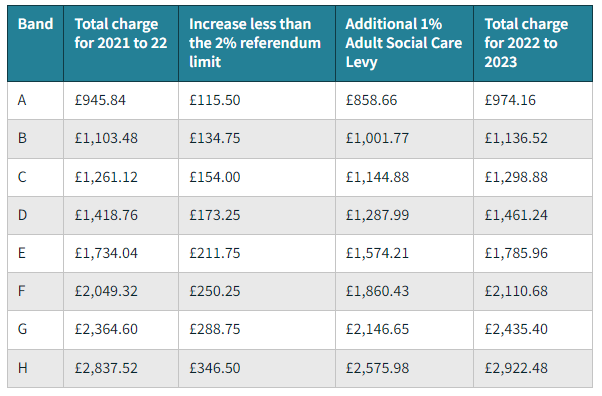
Kent Council Tax 2022/23.
Across the UK, the average council tax band is D, which is likely representative of something like a 3-bed house on a new-build estate. Band G properties are likely to be large, 4-bed detached houses with band H being reserved for the most expensive houses in the best areas.
As a result, if you are moving from an average house where your council tax bill is £1,461 each year to something a couple of rungs up the ladder that falls into band G, you could find your council tax bill rising to £2,435 each year. This is a substantial increase of £974 and may actually represent the biggest increase in the cost of living when moving up the property ladder.
It’s also important to consider that council tax differences from one area to another as they can vary significantly. For example, over in rural Herefordshire, a low population means the full brunt of all council services has to be shouldered by fewer people. A typical band G property in Herefordshire will pay in the region of £1,000 more each year than a band G property in Kent.

Herefordshire Council Tax 2022/23.
The website Property Data has a list that ranks all the region’s council tax for Band D properties, with Westminster being the lowest at £829 in 2021/22 and Nottingham the most at £2,226 in 2021/22.
What are the ongoing maintenance costs of a property?
Given that every house is different, it’s impossible to give any sort of data on the subject of ongoing maintenance costs, however, it’s clear that the newer a house is, the less maintenance it will require. Equally, the smaller it is, the fewer materials will be required and therefore the maintenance costs will be lower. When it comes to upgrading heating systems, the smaller the house is, the smaller the boiler it will need and fewer radiators will be required. The inverse is true with larger houses so it’s definitely worth bearing this in mind when you are comparing houses to buy as the maintenance and replacement of major features can really add up.
Can renewable energy sources help reduce the cost of living?
Some interesting feedback we have had from some of our mortgage clients is how much of a benefit green technologies can be in reducing the cost of living in larger homes. For example, one client recently moved from a 3-bed semi-detached home that was built in 2014 to a large, old 4-bed detached barn conversion that had 17 solar panels installed when the feed-in tariff was still very generous.
As the system was included in the house sale, there was no additional investment to make, but our clients were very pleasantly surprised to find that the system would pay in the region of £2,500 each year for the energy it produced with another decade still to run! In addition to the free electricity it created for use during the day, the system is set to utilise excess energy to run the immersion heater for free, in turn reducing the reliance on gas to heat the water. A very welcome bonus I’m sure you will agree.
Our client’s opinion is that even though the council tax and gas bills are significantly more expensive than their previous, smaller and more modern home, the solar feed-in payments totally offsets this and results in the house actually costing the same to run, even with the recent increase in energy prices, so it’s definitely something to pay attention to when looking for a new home.
Conclusion.
It’s a fairly obvious conclusion to make that larger houses can cost more to run, but, if they are modern enough or if they are equipped with the right level of green technology, it can be the case that larger houses can actually cost less to run than smaller homes. However, regardless of the energy consumption, you can’t escape the increase in council tax associated with larger homes and the maintenance requirements of older homes, so you really need to factor these into your calculations.
Do you have any experience with green technology? Do you have any horror stories of how much a house costs to run? What are your tips for beating the cost of living crisis? Let us know in the comments below and start the conversation.
What’s next?
If you need help or advice with finding the right mortgage, wherever you are in the UK, you can talk through your options with one of our Mortgage Advisors right here in Tunbridge Wells.
This article offers information about mortgages and should not be taken as personal advice. Think carefully before securing debts against your home. Your home may be repossessed if you do not keep up repayments on your mortgage or any other debt secured on it.