
The top 5 things to do with your money in your 50s.

The top 5 things to do with your money in your 50s.
If your 40s are for plugging gaps in your savings, your 50s are about making the final preparations to retire. These are our top 5 recommendations for what to do with your money in your 50s.
1. Start to plan what your retirement finances will look like.
By the time you are in your 50s, you should have a pretty good idea of what your finances will look like over the next decade or so and when you will be able to retire. You will know your personal money habits and your pattern of saving, so you will probably know if you are able to retire early or if you will continue working well into your 60s. Equally, you should have a clear idea of your household budget and how much income you will need in retirement.
You can use our guide to household budgets alongside our budget planning tool and guide to how much money you need in your pension pots to retire to put some of your own figures together.
In terms of plugging the final gaps in your retirement fund, from an investment perspective, the opportunity to take full advantage of compound interest is slightly reduced as you near retirement age. However, that’s no excuse to not continue to save as the gains can still be fantastic if you keep investing for another 10 years. For example, if you have £100,000 in your retirement fund at age 55 and you achieve an annual growth rate of 8%, the overall fund could be worth over £220,000 by the time you are 65. Moreover, if you are able to contribute £500 each month to your fund, your retirements savings could grow to in excess of £310,000 by the time you are 65. Whatever you do, don’t be put off the idea of saving for retirement because you think it’s too late - it’s not. These figures are of course not guaranteed and can go down as well as up.
You can use a compound interest calculator to forecast your own figures or head over to our UK Pension Pot Calculator for a more in-depth calculation.

£100k compounding over 10 years at 8%.
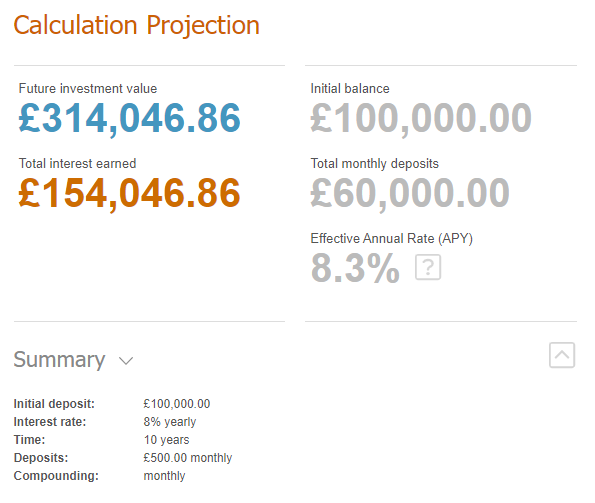
£100k compounding over 10 years at 8% with £500 PCM contribution.
A note about the State Pension.
Don’t forget to check your National Insurance contribution record to make sure you will be entitled to the full State Pension and that there aren’t any gaps. If there are any years to makeup or something doesn’t look right, now is the time to act to ensure you will be getting the full allocation. Your online account will often give you an option to pay a sum of money to add a missed year, although this only goes back so far and gets more expensive as you get older.
2. Reduce your debts and pay off your mortgage.
If you still have debts in your 50s, it’s important to try to reduce them as far as possible or pay them off completely before retirement. The rationale for this is that the lower outgoings you have each month, the less income you will need and therefore the less money you need in your retirement funds to provide that income. Furthermore, the sooner you pay off your debts, the more disposable income you will have before you retire to continue building your retirement fund.
3. Don’t be tempted to spend your retirement savings.
With the ability to take some of your retirement savings as a tax-free cash lump sum from age 55 (increasing to 57 in 2028) and pensions freedoms enabling a greater degree of choice in how you access your pensions, it’s incredibly tempting to treat yourself to a new car, caravan, round the world cruise or home improvements. However, don’t forget that your retirement savings are there to provide you with an income for several decades and cover the cost of any care you may need later in life.
If you’ve accumulated a sum of money that’s far in excess of what you will need, then by all means reward yourself for all that diligent saving. Conversely, if you only have modest retirement savings, the short-term enjoyment of the money could serious affect your long term financial plans, so be sure to think carefully (and seek advice) before spending your capital.
4. Talk to your IFA about the risk profile of your investments.
As you close in on retirement, you may find it beneficial to sit down with a financial adviser to consider how your retirement funds are invested. Typically, the longer your money is invested the greater chance you have to take advantage of cost-averaging and being able to ride the waves of market peaks and troughs. However, once you are in your fifties, you will likely want to begin drawing down on your retirement fund within the next decade or so. If this is the case, you could consider reducing your exposure to investment risk. The modelling can get very complicated though, so your financial adviser is best placed to look at your exact needs and the way your retirement fund is invested.
You may also be aware that, as you get older, your pension pot starts to become the target of innumerable scammers. You may find yourself being cold-called, have glossy financial proposals land on your doormat or see adverts online that promise better than average, guaranteed returns on your investment. Please, ignore them all. A Chartered Financial Planning firm is best placed to advise you on the risks, rewards and possible downsides of your investments and there are some terrible horror stores of people losing it all. Action Fraud has a page dedicated to pensions scams, so be sure to have a read. The old saying always rings true: if it sounds too good to be true, it usually is.
5. Talk to your IFA about the tax efficiency of your investments.
From a tax perspective, the money you have put into a pension over your career is typically untaxed - this usually means pension contributions you or your employer have made each month have not been subject to income tax (gross income) or the tax relief you gained from making contributions to a SIPP after tax has been paid (net income). However, once you start to access your retirement funds, other than a few special exceptions, any capital withdrawals or income you take from a pension will be subject to various taxes and therefore your net income in retirement will be affected to a greater or lesser degree.
On the other hand, since their launch in 1999, ISAs have offered a way to grow your money and receive an income free of taxation. ISAs fall into several camps including the Cash ISA that is little more than a savings account and Stocks & Share ISAs that allow you to invest in the share and bond markets - in many cases, you are able to invest in the exact same funds in an ISA that your pensions are invested in.
ISAs are different to pensions as the money that you pay in has typically already been taxed (net income), but unlike pensions there is no tax relief (with the exception of LISAs which we are not covering here); and there has always been a fairly modest annual limit as to what you could contribute (£7,000 in 1999 rising to £20,000 by 2021). Nonetheless, the total allowances added up since 1999 is over £137,000, so there is every opportunity to have amassed an ISA fund of several hundred thousand pounds by the time you retire. As there are no withdrawal stipulations, any level of cash can be withdrawn at any time, or you can invest in income-producing funds - both options are of course, tax-free.
A tactic we have seen many clients use is to take 25% of their pension fund as a tax-free lump-sum after 55, use this cash to draw an income (if required) and transfer the remainder into an ISA, up to the annual limit each year before subsequently investing in tax-free income-producing funds. However, the significant downside of this course of action is that typically money in a pension is free of Inheritance Tax (IHT), whereas in an ISA it’s not. So this in itself needs careful consideration and advice. This is another case of when the modelling can get quite complicated and individual circumstances will vary, so be sure to talk to a financial adviser before taking any action.
Conclusion.
Your 50s are a great time to review your financial affairs, set your retirement expectations and plan to make the best use of your hard-earned retirement savings. It’s also a great time to make sure that you’ve considered the taxation and risk of your investments.
What’s next?
If you need advice on pensions or how you can invest for the future, you can get in touch with one of our advisors for independent financial advice. We offer a free initial consultation and although we are based in Tunbridge Wells, we advise clients across the UK.
Don’t forget, this article offers information about financial planning and investing and should not be taken as personal advice. Remember that investments and pensions can go up and down in value, so you could get back less than you put in. Tax rules can change and the benefits depend on individual circumstances.