
7 reasons why moving house is terribly stressful.

[*This article was last updated on 30/01/2023.]Introduction.
Our Mortgage Advisers are always dealing with enquiries from both first-time buyers and home-movers looking to remortgage. Although moving house can be incredibly exciting, it’s not always plain sailing. Our Mortgage Advisers break down the top reasons why house moving is terribly stressful and what you can do to stay on top of things.
1. Buying a house involves constant decision making.
Do you like where you live? Perhaps you aren’t that fond of your neighbours, the lockdown has made you realise you need more space or you need to move for a new job? Just deciding you want to move house is a huge decision as sometimes it’s a case of ‘better the devil you know’. Nonetheless, once you’ve decided to push the button on making a change, you are bombarded with decisions to make such as where you want to live, what your budget is, what sort of house do you want to live in?
Invariably, once you’ve got some basic parameters in place, the next step is to start looking around on the property portals like Rightmove and Zoopla and seeing what’s out there in your budget. You may find that your budget won’t actually buy what you’re looking for in your dream location, so you need to make decisions about the compromises you are willing to accept - this could be location, facilities or, as is often the case, increasing the budget. The trick is to keep working at this process until you can easily find a dozen properties that may be worth viewing - just finding a couple of properties in your budget on the portals generally means you can’t afford what you are looking - so it’s back to the compromises.
During this initial property search, you need to get a clear picture of what your own house is worth - Zoopla has a great value estimating tool that may not be 100% accurate, but certainly gives you and your Mortgage Broker an idea of the numbers you are working with. Your Independent Mortgage Adviser can then run through your finances, sense-check your affordability and secure a Mortgage Agreement in Principle; ensuring that your plans are actually in the realm of reality and that you will be able to finance the move.
The next decision you need to make is whether you want to view houses first or put your own on the market. This is generally down to personal preference, however, a good guide is if you NEED to move, then get your house marketed ASAP whereas if you WANT to move, it’s probably better to look at what’s out there and confirm you can afford what you want, before wasting money on the sales process. It may end up the case that you decide to pack the whole idea in and just improve your existing home or stay for a few more years and save money so you can afford the house of your dreams.
Nonetheless, if you’ve managed to get this far and still want to continue the house moving process, you will need to decide which houses to make offers on (and what those offers will be), what sort of estate agent you want to use to sell your current property, what offers you will accept on your own property, which buyer to choose if there is more than one offer, which solicitor to use and the surveys you want to commission - the list of decisions you need to make is practically endless but your Mortgage Adviser is at the end of the phone to help out and offer their expert guidance.
2. You are not in control of the house buying process.
It doesn’t matter if you own your own business and control every aspect of the day to day running of things; when it comes to property buying you need to sit back, relax and understand that you can’t control it. There are so many moving parts, interested parties, slow-moving paper trails and hiccups involved in the house moving process that trying to control them all is just going to make your hair fall out. There are estate agents, buyers, sellers, solicitors or conveyancers, surveyors, removal firms, Mortgage Advisers and mortgage lenders all involved in the process and they all have multiple clients all demanding attention at the same time.
At the end of the day, you just have to roll with the punches. Perhaps the mortgage survey finds issues with the property you are buying that means it doesn’t meet their lending criteria or your own buyers pull out for whatever reason - things are going to go wrong and you just have to stay positive. House buying is like a game of snakes and ladders, you can be almost at the end of the process, only to slip down a snake back to square one.
3. Moving house is life-changing.
Whether you are moving locally or further afield, a house move can be life-changing. Yes, there’s the generic house moving concepts like ‘more time with your family’ and ‘being closer to nature’, but in reality, it’s the everyday things that are likely to cause you stress. For example, if you are moving to a new area, you will need to find a new family doctor, register with an available dentist and locate all those little shops and suppliers you became accustomed to in your old home. If you have children, it’s even worse. You’ve got to consider the schools, clubs and childcare suppliers in your new area and get a whole new system setup.
In relation to the house itself, there are all the new utilities to signup with and any immediate repairs or improvements required to bring the new house up to standard. This could range from simple decorating and carpeting to new kitchens, bathrooms, heating systems, extensions and reconfiguring the layout. Ultimately, the new house could require all of these things and be stressful for months after you’ve got the keys.
Furthermore, you are likely to have chosen to move house because you wanted to change your life and this applies to first-time buyers as much as those hoping to find their forever home. You’ve spent hours trawling through the photos on Rightmove, you’ve picked out the colours for the walls, you’ve even decided on the changes you want to make to the garden - essentially, you’ve already moved-in mentally. This romantic vision of your new life continuously hangs in the balance during the house buying process and any upset or bump in the road could mean it’s all lost. This is incredibly stressful and really, it’s best to not to get too attached until you have exchanged contracts.
Although, interestingly, exchange of contracts doesn’t necessarily mean the jeopardy is over. One of our Mortgage Advisers had a client who was buying a property and the vendor sadly passed away after exchange but before completion. This resulted in a lengthy probate delay but the property eventually completed and the chain could finally complete.
Whichever way you look at it, moving house is going to change your life, but it’s important to keep things in perspective, not get too attached to the dream and take it one day at a time.
4. House buying involves lots of waiting.
Comparing cars with houses, it is possible to buy cars that cost more than houses and have them on your driveway in less than a week, whereas houses take much, much longer before you get the keys. According to the Home Owners Alliance, the typical time taken from listing your property to completion of the sale is about six months in total, as detailed below:
|
Getting a mortgage in principle. |
Approx. 24 hours |
|
Average time from a new home listing on the market to an offer being accepted. |
Approx. 10 weeks |
|
Time from acceptance of an offer to property searches being ordered. |
36 days (over a month) |
|
Arranging the mortgage (which should be done at the same time as the conveyancing process). |
Approx. 3-6 weeks |
|
From searches being ordered to exchange of contracts. |
58 days |
|
From exchange of contracts to completion. |
Same day to 4 weeks |
|
Total time from new property listing to completion of the sale. |
Approx. 6 months |
How long does it take to sell a house in the UK?
Unfortunately, the longer the process takes, the more chance there is for things to go wrong. For example, your mortgage offer could expire, your buyers could face a change in situation and decide they no longer want to move, and anyone in the chain could pull out at any moment, causing a collapse in the whole process. For this reason, our Mortgage Advisers suggest that you need to choose the offer you accept very carefully - sometimes its better to take a lesser offer because of their situation.
Our Advisers believe that cash buyers without a property to sell are the number one buyer and typically end up having the fewest moving parts and shortest time to completion. The second best buyers are either cash buyers with a property to sell or those without a house to sell but require a small mortgage. You win some, you lose some with these buyers. Cash buyers don’t need a mortgage which removes one cog, but no chain means the sale is only dependant on a valid mortgage offer. By far the least desirable buyers are those that are in a long chain and require a large mortgage - both of these positions leave the process open to problems and are more likely to collapse or suffer delays as a result.
5. Surveys are full of surprises for home buyers and sellers.
There are two schools of thought on having a survey done on the property you are buying. The first is that you pay out money upfront to go into the property transaction with your eyes open; and the other considers that homebuyer’s surveys are so over the top that the results would cause any sane person to forget the whole thing and give up on moving forever. Some buyers are content that if the survey carried out by the mortgage lender results in them being happy to lend against the property, there can’t be anything that wrong with it and any potential issues can be fixed as they crop up in the fullness of time. Only you can decide on the level of survey you are happy with.
The important thing to remember is that surveyors are being paid for their professional opinion on a property and they have to be extra vigilant and cautious when putting their name (and professional indemnity insurance) to a survey. This means that properties old and new are likely to have a list of possible defects in the survey report, even where the current owners haven’t experienced any problems in years.
It’s also important to be aware that the results of a survey can be used as a bargaining tool to reduce the price or require sellers to undertake certain works prior to completion. All our Mortgage Advisors can say is that everyone is much happier once the survey phase is over!
6. Moving house can cost a fortune.
The cost of moving house in the UK can be incredibly high and this helps to raise the game in terms of stress, so it’s best to do it as few times as possible. If you haven’t planned and budgeted properly, you could end up having to find money you don’t have. To help you out, our Mortgage Advisers have broken down the key costs encountered during a house move.
Stamp duty.
The Tax Service has a useful stamp duty calculator but as an example, a property valued at £750,000 will be liable to a stamp duty bill of £25,000 on the basis that it is a straightforward purchase by a family looking to move up the property ladder. Anything involving numbers like this can be very stressful.
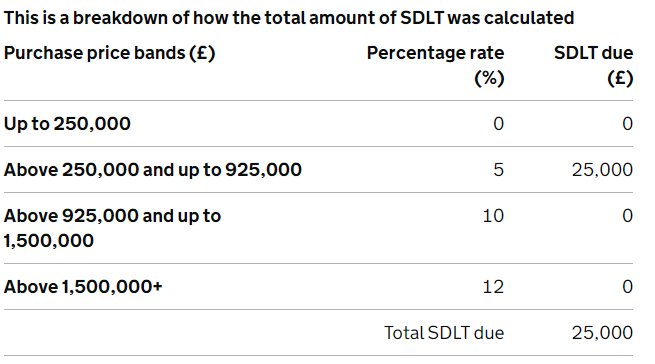
SDLT Calculation on a house worth £750,000.
Deposit.
Depending on how you are financing a property, you typically need at least 5% to 20% of the purchase price available in cash (or existing equity) to secure a mortgage.
Valuation fees.
You will often need to pay for a valuation survey to be undertaken by a surveyor on behalf of your mortgage lender. These fees vary from lender to lender and the size of the property but expect to pay anywhere from £150 to £1,500.
Private survey fees.
Should you decide to pay for an independent survey of a property you are buying, you will need to budget anywhere from £250 to a couple of thousand pounds, depending on the detail of the survey you require and the size of the property.
Legal fees.
You will need to pay a fee to sell your house and another for the purchase for the new property. Including the searches and transfer fees, you can budget anywhere between £1,000 and £3,000 for this part of moving house. If you have an existing Help to Buy scheme or are taking one out as part of the purchase, this will incur additional costs.
Estate agent fees.
Historically, estate agents have charged between 1% and 3% of the value of your home, plus 20% VAT to sell your property. On a £300,000 house, this could range between £3,600 and £10,800. On a £750,000 house, this would range from £9,000 to £27,000, which is another eye-watering cost to bear. However, our Mortgage Advisers have noticed a move to online estate agents such as Purple Bricks charge a much more reasonable, fixed fee of only a few hundred pounds, depending on the package you choose. Incredibly, some estate agents including Strike and Sold will now sell your house for free as they get paid via mortgage referrals, removal quotes, surveys and the like.
Removal costs.
These vary depending on the size of your property, how much stuff you own and the distance to the new property. Our Mortgage Advisers suggest budgeting anywhere from £600 for smaller properties to several thousand pounds for much larger homes. Don’t forget though that you can save a lot of money by doing it yourself with a few friends and a hired van.
Mortgage fees.
Your mortgage fees will typically fall into three different types; booking fees of a few hundred pounds, arrangement fees up to a couple of thousand pounds and valuation survey fees of a few hundred pounds. Your Mortgage Adviser will be able to outline the costs associated with each of the lenders.
Cleaning costs.
In a perfect world, buyers and sellers would all have their houses thoroughly cleaned once the property is vacated. In reality, this is not often the case. As a result, you may wish to budget a few hundred pounds to have the house you’re buying professionally cleaned, paying particular attention to the carpets, kitchen and bathrooms.
Immediate fixing fund.
Without doubt, you will find several jobs that need doing when you move into your new house. From decorating the bedroom to fixing leaky taps and changing the locks; it’s useful to have a fund set aside to take care of the myriad things that will need attention.
7. It’s not over until you have the keys in your hand.
So you’ve jumped through the hoops, you’ve allocated funds for every eventuality, survived the survey stage and mentally moved in. However, things can still go wrong right up until completion. Just remember to always think of moving home as a game of snakes and ladders - one day it seems like you are making great progress, another and it feels like nothing at all is happening, only to be followed by bad news that puts you back weeks or months. Until you have those keys in your hand, the removers have left and you are settling down to your first evening in your new home with a glass of something cold in your hand, try to stay as detached from the process as possible and don’t pin all your dreams on moving home to keep the stress levels under control.
What’s next?
If you need help with your mortgage, you can talk through your options with one of our mortgage brokers right here in Tunbridge Wells. We also have a more in-depth article on calculating the costs of buying a house.
This article offers information about mortgages and should not be taken as personal advice. Think carefully before securing debts against your home. Your home may be repossessed if you do not keep up repayments on your mortgage or any other debt secured on it.