
What’s better: Active or Passive Investing?

When you’re looking to invest in shares or bonds, you may think about putting your money into one or more funds. You can find funds which invest in a wide variety of markets and sectors.
But wherever you invest, your fund managers will take one of two basic approaches to managing your money: active or passive investing.
Let’s start by understanding the difference between the two approaches.
Fund managers who use an active investment approach aim to either outperform a given equity or bond market, often represented by an index, or they aim to achieve a specific investment objective.
They do this by selecting investments based on their experience and knowledge, and an assessment of each investment’s worth. They are trying to choose the best investments. Some of the research will be programme-based, but they also require research analysts and portfolio managers to manage the process. As a result, they tend to trade more frequently and this additional work means their costs are often higher than those of passive funds.
Passive fund managers generally believe it is difficult to out-think the market, so they try to match the performance of the market (or their chosen sector) as a whole, rather than trying to beat it.
They tend to do this by closely following or tracking an investment index, such as the FTSE 100 Index of the UK’s biggest 100 companies. That’s why passive investments are often called ‘index funds’ or ‘tracker funds’. The work is often much more quantitative and programme-based than active management and because of this, passive funds are often offered at a much lower cost.
So which is best?
Well, there is no definitive answer to this. But let’s way up the pros and cons of each:
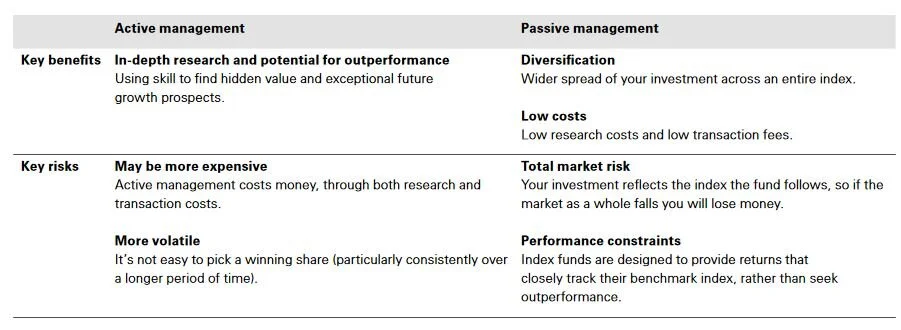
Source: Vanguard
Still none the wiser?
Studies have shown that it is extremely difficult for active funds to regularly outperform the market. This involves the need to predict events and their precise timings, and one can argue that the common mantra of ‘time in the markets, not timing the market’ plays to the argument for passive investing.
There has certainly been a growing trend towards passive investing in recent years. But this in itself is creating competition and placing pressure on active managers to lower their costs. The result is that there are some very competitively-priced actively managed funds available.
During the last year, we have seen volatility in the markets and there has been pressure on both active and passive managers. From the buoyancy of the fourth quarter of 2019 into the start of 2020, to the sharp market falls in February and March due to the global pandemic, this was a test of both strategies. So who did best? Only time will tell.
What about sustainable or responsible investment options?
For many years, sustainable investing was dominated by active fund managers. However, as the demand for sustainable and responsible investing has grown, so has the demand for lower-cost options. A quarter of sustainable funds are now managed through passive investment strategies. As with conventional funds, passive sustainable funds tend to be cheaper than their active counterparts.
There are many different types of sustainable and responsible investing passive funds. Some use an exclusions-based approach and won't invest in industries like tobacco, munitions and coal. They could do this by:
Tracking a screened index, like the FTSE4 Good or the Dow Jones Sustainability Index; or
Tracking an index that hasn’t been screened, like the FTSE All-Share, and investing in all of the companies in that index that meet their criteria.
Other passive funds invest in all the companies in a given index, but adjust the size of their investments depending on how well each company scores against a set of environmental and social criteria.
Our view
We believe it’s better to have a best of both worlds approach; with some money invested in active strategies and some in passive. This can be done by selecting the best actively managed funds or portfolios and the best passively managed funds or portfolios; or it can be done by selecting those that purport to do a bit of both.
If you would like to find out which approach may be most suitable for you, or if you have any questions about investing, please get in touch and one of our Independent Financial Advisors (IFAs) will be happy to help.
This article offers information about investing and should not be taken as personal advice. Remember that investments can go up and down in value, so you could get back less than you put in.