
What is the Price/Earnings Ratio? The definition of P/E.

What is the Price/Earnings Ratio? The definition of P/E.
An introduction to the Price/Earnings Ratio.
For anyone reviewing the relative value of a share, the Price-Earnings Ratio, commonly referred to as the P/E ratio, is a widely used metric. The Price Earning Ratio measures a company's current share price relative to its per-share earnings.
The P/E Ratio offers a quick insight into what the market is willing to pay for a share based on its past or future earnings. It also acts as a comparison tool within an industry and across the market as a whole.
Despite its widespread usage, the P/E ratio is often misunderstood or misinterpreted by many. This article aims to provide clarity on this important topic.
Understanding the Price/Earnings Ratio
The P/E ratio compares a company's current market price to its per-share earnings. It provides a relative value of a company's shares, indicating how much the market is willing to pay for each pound of earnings. This ratio is widely used to gauge a company's investment attractiveness and valuation.
The Price/Earnings Ratio is made up of:
Market Price per Share: This is the current price at which a company's shares are trading on the stock market. It reflects the company's current valuation in the market.
Earnings per Share (EPS): EPS is a company's profit divided by the number of outstanding shares. It serves as an indicator of a company's profitability on a per-share basis. EPS is based on past (trailing) or future (projected) earnings.
How to calculate the Price/Earnings Ratio?
The P/E ratio is calculated by dividing the market price per share by the earnings per share, as follows:
P/E Ratio = Market Price per Share / Earnings per share.
Two examples of the Price/Earnings Ratio.
To help put the Price/Earnings Ratio into context, we can compare two companies in the telecoms sector: BT Group PLC and Vodafone Group PLC. You can get the live data from Google Finance.
The image below shows BT Group PLC has a Price Earnings Ratio of 5.82 (highlighted in red). We can also work backwards from the information given to work out the EPS. So, if the share price of £1.074 and the P/E Ratio is 5.82, the Earnings Per Share (EPS) would be approximately £0.185 (Share price / P/E Ratio).
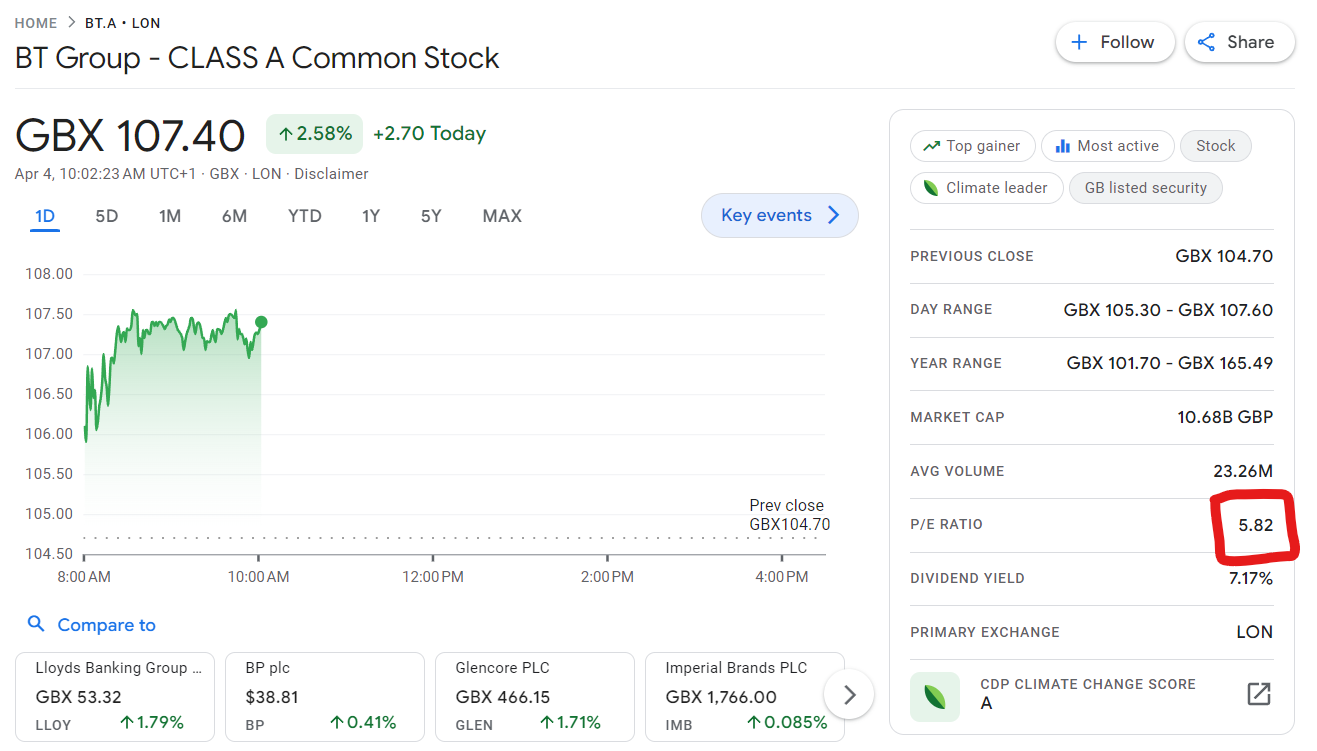
BT Group PLC Price Earnings Ratio (Image: Google Finance).
If one was comparing investments across the telecoms sector, Vodafone Group PLC would be a natural competitor. The image below shows a P/E Ratio of 2.18. Again, working backwards, the EPS would be £0.3291.

Vodafone Group PLC P/E Ratio (Image: Google Finance).
What does the P/E Ratio mean?
The simple P/E Ratio calculation yields a number that offers significant insight into a share's relative value. For example, a higher P/E Ratio may suggest that a company is expected to grow significantly in the future, whereas a lower P/E might indicate that a company is undervalued or facing challenges.
Essentially, the higher the P/E Ratio, the more investors are willing to pay a premium for shares in a company. The lower the P/E Ratio, the less attractive a share is to the investment market, and a certain degree of risk exposure is priced in via a discount.
How is the Price/Earnings Ratio used in investment analysis?
The price-earnings (P/E) ratio is one tool many investors use when evaluating stock market investments. The P/E Ratio is used for several applications, including:
As a valuation tool: The P/E Ratio is primarily used to assess whether a stock is overvalued or undervalued.
To compare companies: The P/E Ratio allows investors to compare the value of companies within the same industry.
As a measure of market sentiment: The P/E Ratio can also reflect the market's sentiment towards a company.
What are the limitations of the Price/Earnings Ratio?
While the P/E Ratio is a valuable tool, it has limitations. One key limitation is that it does not take into account companies' growth rates, and the ratio does not account for debt. As such, the P/E Ratio should not be used in isolation but rather as part of a broader financial analysis.
What are the different types of Price/Earnings Ratios?
As with most things financial, once you scratch the surface, things get a little more complicated, and the Price/Earnings Ratio is no different. Therefore, it's essential to understand that there are two main types of P/E Ratio:
What is the Trailing Price/Earnings Ratio?
The Trailing P/E Ratio is based on past earnings. It is calculated by dividing the current market price per share by the total earnings per share over the previous 12 months. This ratio provides a measure based on actual, historical performance.
Because it is based on actual data, Trailing P/E is often seen as a more reliable indicator, and it is particularly useful for assessing the current valuation of a company in a stable economic environment, where past performance can be a good indicator of future performance (although this is not always the case).
What is the Forward Price/Earnings Ratio?
The Forward P/E Ratio is calculated by dividing the current market price per share by the projected earnings per share for the next 12 months. This ratio is highly speculative as it relies on forecasts and analyst estimates, which can easily be incorrect.
Investors often use the Forward P/E to gauge a company's future growth potential and share price increase. This is particularly relevant in dynamic industries, where future growth prospects and potential are crucial for investment decisions.
What is the difference between the Trailing P/E Ratio and the Forward P/E Ratio?
The main difference between Trailing and Forward P/E lies in their basis of calculation—historical earnings versus future earnings projections. As a result, Trailing P/E is often used to evaluate a company's current financial health, while Forward P/E is more about its future potential.
The choice between using Trailing or Forward P/E depends on the investment strategy and the specific sector in which a company operates. For instance, industries with rapid growth warrant more attention to Forward P/E, while more stable, established industries are better assessed with Trailing P/E.
Conclusion.
The Price/Earnings Ratio is a simple tool on the surface. Still, it has the potential to offer significant insights into a company's market valuation, investor sentiment, and sector-specific dynamics. The value derived from the P/E Ratio depends significantly on its interpretation within the appropriate context, including industry norms, economic conditions, and market sentiments.
There are two types of Price/Earnings Ratios: Trailing and Forward P/E ratios. Each, with its unique focus, provides various perspectives on a company's financial standing and prospects.
It's important to remember that the 'normal' P/E Ratio varies across sectors, emphasising the need for sector-specific benchmarks when making any valuation assessment. Equally, while the P/E Ratio is helpful for comparative analysis, it should be only used in conjunction with other financial metrics and ratios to provide a more complete picture of a company's financial health and investment potential.
What’s next?
If you need help or advice on your personal finances or if you want to consider investing to make your money work harder, you can get in touch with one of our advisors for independent financial advice. We offer a free initial consultation. Based in Royal Tunbridge Wells, we advise clients across the UK.
Don’t forget, this article offers general financial information and should not be taken as personal advice. Remember that investments and pensions can go up and down in value, so you could get back less than you put in. Tax rules can change and will depend on your individual circumstances.