
What is the life expectancy in the UK and what does it mean?

Without being too morbid, life expectancy affects all of our plans. From how much we need to retire, when we can retire to annuity rates and care funding, we all need to understand the arc of life and make plans accordingly. The question is though, what is the life expectancy for men and women in the UK?
What does life expectancy mean?
Life expectancy is a generic term that measures the health of a population via an average age of death. It can also be expressed as how long, on average, people can expect to live using an estimate of a country’s population and the number of deaths. Only a few hundred years ago, the average life expectancy across the world was only around 30 years. Today in the UK, the average life expectancy for a male born today is 88 years and 90 for a female. By contrast, the country with the lowest life expectancy is the Central African Republic with its population living just 53 years on average.
Is life expectancy increasing in the UK?
Over the past century, life expectancy has increased significantly each decade as a result of improvements in the health of the country. However, the ability to extend life expectancy has plateaued since about 2011, according to the ONS. For example, in the early 2000s, life expectancy was increasing by an average of nearly 15 weeks each year whereas, in recent years, this growth has slowed to about 5 weeks each year. Interestingly, since the early 80s, the life expectancy for males has been increasing at a faster rate than females, but this has now levelled out, slightly in favour of increasing female life expectancy. Conversely, South Korea, Denmark, Norway and Finland are all seeing strong increases in life expectancy.
Factors which have contributed to increases include safer working conditions and a move away from both agriculture and manufacturing to service industries, which are far less physically dangerous. Equally, the reduction in the number of men that smoke has resulted in a levelling up of the proportion of males that smoke when compared to females.
In 1980, 42.4% of men aged over 16 years in the UK smoked compared with 36.8% of women;
In 2019, this had reduced to 17.9% of men and 13.8% of women.
In 2011, Public Health England released a report examining the slowdown in life expectancy in the UK and concluded it was down to several factors, including seasonal flu virus (expect Covid-19 to be no different), which can disproportionally affect an increasingly older population, particularly those living with dementia and Alzheimer’s. Additionally, the world is seeing a levelling-off in improving mortality rates from heart disease and strokes as people continue to smoke, have high blood pressure and obesity increases. Additionally, an increase in deaths in younger people from drug misuse and suicide is also contributing to the slowdown in improvement.
Where in the UK has the lowest life expectancy?
Fortunately, all countries in the United Kingdom are holding steady or seeing improvements in life expectancy. England has the highest current life expectancy of 79.7 for males and 83.3 for females, whereas Scotland has the lowest with 77.1 for males and 81.1 for females. This means that a female in England can expect to live for just over 6 years longer than a male in Scotland.
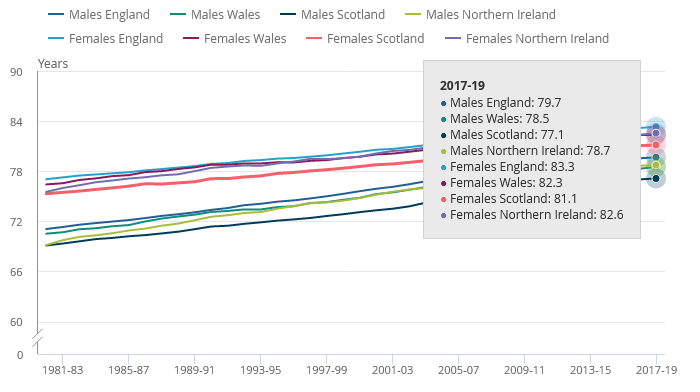
UK countries life expectancy compared.
What’s more interesting is that life expectancy also varies based on where you live regionally, topped by the North East of England, which has a life expectancy even lower than Scotland. Conversely, the further south you live in the UK, the longer your life expectancy is by approximately 3 years. With specific towns and cities in mind, Westminster, Camden and Kensington & Chelsea have the highest life expectancies overall for both makes and females whereas Glasgow, Dundee, Inverclyde, West Dunbartonshire and Blackpool are bottom of the list for both males and females.
What areas of the UK have a declining life expectancy?
In recent years, some areas of the UK have actually seen a sharp decline in life expectancy. Most notable for men are North Kesteven in Lincolnshire and Tonbridge & Malling right here on our doorstep, where life expectancy has reduced by over a year. Whereas for females, King’s Lynn, West Norfolk, Stoke-on-Trent, North Kesteven and the Scottish Highlands have all seen life expectancies reduce by about a year. The reasons for these declines are unclear.

Life expectancy declines for local areas of the UK.
What is the life expectancy in Tunbridge Wells?
According to the Office for National Statistics, males at birth can expect to live 81.5 years whereas females can live to be 84.6. In those that are already aged 65, males can expect to live for another 20 years and females can expect to live for another 21.9 years.
How can I check my life expectancy?
We have a dedicated page on our website with both a basic life expectancy calculator and a UK life expectancy map. All the tools are powered by the Office for National Statistics and it only takes seconds to see the results.
What’s next?
If you need help or advice with your finances and investment decisions, you can talk through your options with one of our Financial Advisors right here in Tunbridge Wells.
This article offers general information and should not be taken as personal advice.