
What is gold and is gold a good investment in the UK?

Is gold a good investment and what is the gold price?
What is gold?
Gold is bright, dense, malleable metal that is found as nuggets or grains in rocks and soil. It is a relatively rare metal that has historically been used for both jewellery and art, plus gold coins were minted for currency circulation until the 1930s, which is known as the gold standard. However, this was abolished for a fiat monetary system after the outbreak of the Second World War.
Where is gold found?
Gold is found all over the world, but the biggest miners in 2019 were China (383 tonnes), Russian Federation (329 tonnes), Australia (325 tonnes), United States (200 tonnes) and Canada (182 tonnes). South America, Asia and Africa were also large miners. The only countries in Europe to mine gold in 2019 were Sweden (8 tonnes) and Finland (7.7 tonnes), which along with New Zealand (7.8 tonnes) make up the bottom three countries in the world.
How much gold is in the world?
According to the World Gold Council, a total of 197,576 metric tonnes of gold are above ground. A fully-laden articulated lorry in the UK weighs-in at 44 tonnes. Therefore, the amount of above ground gold is equivalent to nearly 4,500 of these lorries. Here in Kent, Marston Airfield was recently used as a lorry park following the boarder-closure with France and it has a capacity in the region of 4,000 lorries, so the amount of gold that exists weighs more than all the lorries you see below.

The total weight of gold that is ‘above ground’ is made up of:
Jewellery: 92,947 metric tonnes (47.0%)
Private investment: 42,619 metric tonnes (21.6%)
Official holdings: 33,919 metric tonnes (17.2%)
Other: 28,090 metric tonnes (14.2%)
It is also currently estimated that there are a further 54,000 metric tonnes in ‘below ground reserves’ and each year, global gold mining extracts upwards of 2,500 tonnes to add to the ‘above ground’ stocks. Interestingly, at the current rate, this means that the current known below ground stocks will be above ground in under 22 years. Furthermore, the rate at which gold is mined depends largely on the gold price because some gold is only economically viable to extract if it can be sold for a high price.
What is the Gold Standard?
The gold standard refers to two points in history when money and currency have been linked with gold.
The Classical Gold Standard started in the 1870s when most countries (other than China and some Central American countries) fixed the value of their currency to a specified amount of gold or the currency of a country that did so. Under this system, a currency could be readily converted into gold at a fixed price and gold coins could be used alongside the circulating currency and central banks had to maintain a set ratio of physical gold to the currency issued. Because each currency was fixed to a set price of gold, the exchange rate between different currencies was equally fixed.
The Bretton Woods system is named after a conference that was held in the United States in 1944, whereby it was decided that the US Dollar should be at the centre of the world financial system as the world rebuilt after the Second World War. As a result, the US Dollar was fixed at $35 per ounce, whilst other countries around the world had fixed but adjustable exchange rates to the dollar - giving nations the power to stimulate their economies without suffering penalties. However, by the 1960s global inflation meant that the price of gold was too low in real terms which meant that the levels of international gold reserves became inadequate. After several attempts to keep the US Dollar pegged against gold, in 1971 President Nixon ended the on-demand convertibility of Dollars into gold and the Bretton Woods system collapsed, allowing gold to be traded freely on the world’s markets.
How much gold does the UK have?
Gold reserves are one of the measures that a country’s central banks take to insure the country against financial collapse. At the end of the Second World War, it is estimated that Britain had in excess of 1,772 tonnes of gold in reserve, the equivalent of 40 articulated lorries. This figure peaked in 1958 at 2,495 tonnes or 56 articulated lorries.
By the time the gold standard ended in 1971, the UK sold-off nearly half of its gold, leaving a reserve of just 690 tonnes. This level then remained fairly steady until 1999 when the then Chancellor of the Exchequer, Gordon Brown, decided to sell-off 145 tonnes of gold because he considered the value of gold to be too volatile (Switzerland, Belgium, Canada and the Netherlands were also selling large amounts of gold at the time). This resulted in the UK’s gold reserves falling to 355 tonnes.
In a spectacular misjudgement, the price of gold has subsequently risen dramatically and Gordon Brown’s decision is now known as ‘the worst investment decision of all time’. At the point of sale, gold was at the bottom of a 20-year bear market and was selling at around £5.5 million per tonne. Today, a tonne of gold is worth in the region of £40 million per tonne, and the gold sold in 1999 would now be worth billions.
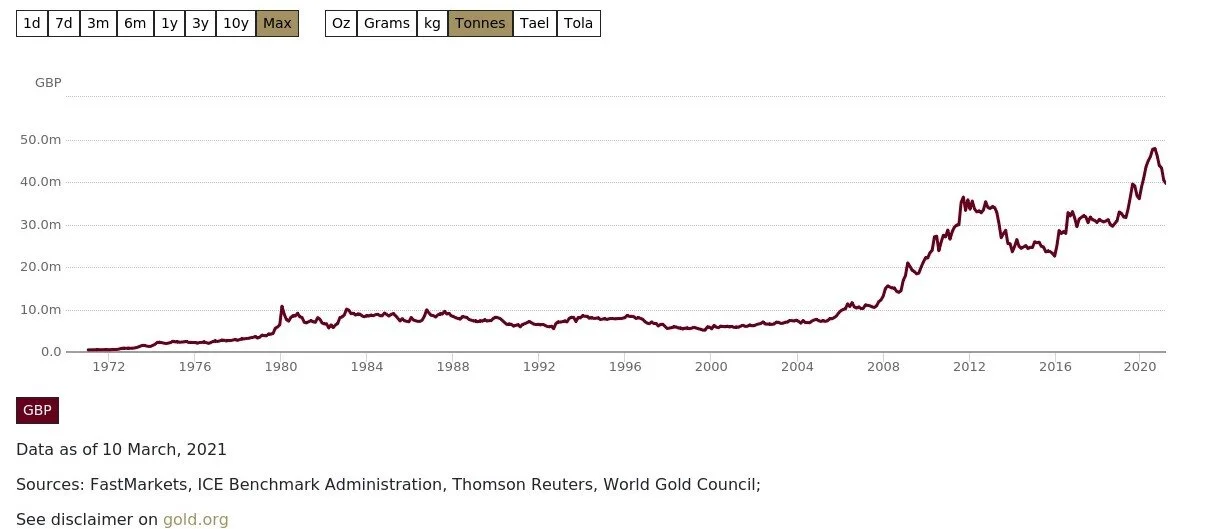
The current estimate for UK gold reserves is just 310 tonnes or the equivalent weight of 7 fully-laden articulated lorries. In theory, it would be easy for the UK Government to move the UK gold reserves right past your house in a few seconds and you would never notice. In fact, during the Second World War, a large proportion of the UK’s much larger gold reserves were moved to Canada under a secret operation, known as Operation Fish.
The UK’s gold reserves are held in the vaults of the Bank of England, along with the reserves of many other countries around the world due to the perceived security of the UK. It is reported that the Bank of England’s vaults contain around 400,000 bars of gold worth over £100 billion and only the Federal Reserve in the USA holds more.
What is the current gold price?
The value of Gold recently peaked in August 2020, during the Coronavirus pandemic, at just over £50,000 per kilogram, or a little over £50 per gram. This value has continued to fall as the vaccine rollout continues and, at the time of writing, a kilogram of gold is priced at just shy of £40,000 which makes a gram of gold worth around £40. Click the button below to check the latest gold prices.
Why do people invest in gold?
Some people invest in gold as they see it as a strategic asset that is subject to several sources of demand. As previously mentioned, it is used as an international reserve currency, it is also used as a conductor in electronic production and it is heavily used by the jewellery industry. Equally, as an asset, it is is readily liquid, available in small denominations, scarce, not subject to any credit risk, not controlled by a single body, internationally recognised and has a historical record of preserving value.
Is gold a good investment?
There are different ways of investing in gold, including physical gold, shares in gold mining companies, and ETFs, but here we look briefly at investing in physical gold. Because gold doesn’t produce an income, it is difficult to compare it to shares that provide dividends or bonds that provide a coupon. Traditional financial investments are often valued by comparing book values, price to earnings ratios, expected earnings, discounted cashflows (DF) whereas gold cannot. The value of gold is often driven by:
Economic prosperity that leads to an additional demand for jewellery, technology and savings.
The uncertainty of traditional market where downturns result in the increased demand for gold.
The relative attractiveness or otherwise of alternative investments, such as low-interest bonds.
Movement in bull and bear markets whereby trends amplify demand to buy or sell gold.
As seen over the past year, the global pandemic saw large increases in the value of gold as the fallout of global trade and manufacturing hit stock markets like a bomb. Investors that made a move in early 2020 or already held gold were able to take advantage of the rising market momentum. However, given how quickly the gold market can change on the back of good news, the value swiftly dropped again in the summer once vaccine trials were underway. Confirming, as ever, timing can hugely affect the returns of an investment.
What are the risks of investing in gold?
All investments, including investing in gold, are subject to risk, including the possible loss of the money you invest. Gold is a commodity and these have specific risk characteristics, including:
They have no means of traditional valuation. The price is based solely on supply and demand from multiple global interests. Attempting to derive a valuation or expected return is difficult at best and guesswork in most cases.
Because of this, prices can be extremely volatile, rising and falling rapidly based on changing economic and political conditions, and on the whims of the marketplace.
And while it’s easy to look back on the increase in gold prices over the past 40 years, past performance is no guarantee of future returns.
Nonetheless, depending on your position and financial goals, gold could be a useful part of a diversified portfolio. You may however want to review how any gold you buy is mined and manufactured though to ensure it aligns with your ESG requirements.
What’s next?
We have many years’ experience of providing advice on pensions, retirement planning and the associated areas of advice, such as tax, estate planning, equity release and long-term care. As Chartered Financial Planners, we are at the forefront of the financial advice profession. You can learn more about what this means in our article on being a Chartered Financial Planner. You can also contact us to arrange a free initial consultation.
Please note this article offers information about financial planning and should not be taken as personal advice. The value of pensions and investments can go up and down in value, so you could get back less than you put in. Tax rules can change and the benefits depend on individual circumstances.