
UK Salary Inflation Calculator: Are your earnings keeping up?

UK Salary Inflation Calculator: Are your earnings keeping up?
Introduction.
Inflation is the increase in prices of the everyday things we buy; from food to cars, transport to housing. Unless salaries keep pace with inflation, the amount earned will buy less and less each year.
On the back of some incredible increases in the costs of living, many employees and business owners in the UK may be left wondering if their salaries are truly keeping up. Equally, the first rule of any salary review is that a pay rise is not always a pay rise. Unless the percentage increase is greater than the current rate of inflation, a pay rise may actually end up being an effective pay cut.
Our UK Salary Inflation Calculator is a valuable tool designed to help you assess whether your income growth aligns with the increased cost of living. In this article, we'll explore how to use this calculator effectively and discuss strategies to ensure your earnings stay on track.
What is salary inflation?
While nominal salary growth might seem promising, it's essential to consider whether these increases are sufficient to maintain your standard of living. For instance, if your salary is set to rise by 3% next year but inflation is at 2.5%, your real income, which is the amount of goods and services your money can buy, is only growing by 0.5%. On the other hand, if your salary is set to increase by 2%, you will actually be 0.5% worse off next year. Understanding this dynamic is key to making informed financial decisions whenever your salary is reviewed.
The importance of tracking your salary growth.
Tracking your salary growth is not just about keeping an eye on your paycheque. It's about ensuring your long-term financial stability, giving you a sense of security and reducing uncertainty about your financial future.
Consistent, above-inflation salary increases can bolster your savings, enhance your investment portfolio, and help you achieve significant milestones like homeownership or a comfortable retirement.
Conversely, neglecting to monitor salary growth can lead to wage stagnation, where your earnings fail to keep up with inflation, eroding your purchasing power over time.
What factors affect salary increases in the UK?
There are several factors that influence salary increases in the UK, with each playing a pivotal role in determining your earning potential:
Company profitability: If your company's products or services are in high demand and they are able to increase their prices in line with inflation, it is much more likely that there will be sufficient money in the business to offer company-wide pay rises that match inflation. However, the opposite will also be true in industries where there is little control over pricing (such as farming).
Industry trends: Sectors experiencing high demand, such as technology, are often able to offer more substantial, above-inflation pay rises compared to other, more saturated fields.
Skillset and experience: Professionals with specialised skills or extensive experience are more likely to receive higher than inflation pay raises.
Economic conditions: Overall economic health, including GDP growth and unemployment rates, can impact salary trends across the board.
Six strategies to ensure your salary keeps up with inflation.
To ensure your salary keeps pace with inflation, you could consider implementing the following strategies:
Upskill continuously: Invest in learning new skills or obtaining relevant certifications to increase your value to employers. Whether mastering new software, learning a foreign language, or acquiring a professional certification, continuous learning can make you indispensable and more likely to receive an above-inflation pay rise or promotion.
Effective negotiation: When the time comes for performance reviews or job offers, negotiate your salary assertively, backed by market data and your personal achievements. Prepare a compelling case highlighting your contributions and the value you bring to the organisation.
Explore new opportunities: Sometimes, advancing your career in order to increase your salary faster than inflation may require seeking new roles or talking to companies that offer better compensation packages. Stay open to opportunities that align with your career goals and financial aspirations.
Invest in education: Additional qualifications can open doors to higher-paying positions and career advancement. Consider pursuing advanced degrees or specialised training to enhance your expertise.
Network actively: Building a robust professional network can lead to new opportunities and insights into salary trends within your industry. Attend industry events, join professional associations, and engage with peers on platforms like LinkedIn.
Join a union: If you lack the confidence to negotiate your salary as an individual or are happy in your current role but want to ensure your salary is not eroded, you could consider joining the union to negotiate pay rises on behalf of all members. There are other benefits, too. However, some negotiations can take longer, and you may not always be happy with the result. It's important to weigh the potential benefits against the drawbacks before making a decision.
Finding this useful?
Once a month, we send our latest articles on pensions, investments, mortgages, protection, estate planning and more - along with a couple you might have missed. Practical reading for anyone taking their finances seriously.
Join our readers →UK Salary and Wage Inflation Calculator.
What should my salary be next year to keep pace with inflation?
Using data from the Office for National Statistics, our interactive calculator allows you to calculate what your salary should be next year, to keep pace with inflation. All you need to do is enter your current salary into the calculator to find out what you should be earning next year to maintain your buying power.
How to use our UK Salary Inflation Calculator.
Using our UK Salary Inflation Calculator is straightforward and can provide invaluable insights into your financial trajectory. Here's how to make the most of it:
Input your current salary: Enter your gross annual earnings.
Analyse the results: The calculator will display how your salary stacks up against inflation. The results will show you what your pay would need to increase to in order to keep up with the current inflation rate and maintain its buying power and how much that pay increase would be as a number. To put your figures in context, the calculator will also show what your salary would need to be if your pay increased in line with the current average pay growth.
Decide if the figures proposed are appropriate: Your final step is to make a judgment call as to whether or not the proposed pay rise is fair and acceptable. For example, if you are required to take on more responsibility for a below-inflation increase in your salary, you may decide to pursue other options. On the other hand, you may decide that a short-term decrease in your spending power is necessary to achieve a more significant pay rise or promotion in the future.
Conclusion.
In an economy where inflation rates can significantly impact the value of your money, staying informed about your salary growth is essential. Our UK Salary Inflation Calculator serves as a useful tool, providing clarity on whether your earnings are keeping up with rising costs.
By understanding the factors that influence salary increases and implementing strategies to boost your income, you can secure a fair reward for your work and a stable financial future.
What's next?
Wherever you are in the country, we invite you to book a free initial consultation with one of our experienced financial advisers for expert advice and guidance on any matters relating to retirement planning, pensions, investments and more. Based in Tunbridge Wells, Kent, we proudly serve clients across the UK.
Locally, we serve clients across Kent, including Ashford, Maidstone, Sevenoaks and Tonbridge. In East Sussex, we have clients in Bexhill, Crowborough, Eastbourne, Hastings, Heathfield and Uckfield.
Don't forget, this article offers general financial information and should not be taken as personal advice. Remember that investments and pensions can go up and down in value, so you could get back less than you put in. Tax rules can change and will depend on your individual circumstances.
UK Salary and Wage Inflation Calculator FAQs.
What is a UK Salary and Wage Inflation Calculator?
Our UK Salary and Wage Inflation Calculator is designed to help you take charge of your financial future. In today's world, your income must keep up as the cost of living continues to rise otherwise you will be worse off in the long term.
Whatever stage you are at in your career, understanding salary and wage inflation is essential. Our calculator helps you to put a realistic figure on how much your salary should rise this year to maintain the same purchasing power. Is the figure you are being offered a true pay rise or is it actually less than inflation? This calculator gives you the official numbers to work with and helps you negotiate with your employer.
What is inflation and how does it affect my salary?
Inflation is the amount that the cost of goods and services increases by each year. To be able to purchase the same amount of goods or services in the future, your annual salary needs to grow at the same rate as inflation.
If the rate of inflation is more than your salary increase, every pound you earn will buy less. Therefore, you will need to spend an increased percentage of your take-home pay to buy the same goods. This would result in a lower standard of living.
If your salary increases at a higher rate than inflation, every pound you earn will buy more. Therefore, you will need to spend a decreased percentage of your take-home pay to buy the same goods. This would result in a higher standard of living.
What is the history of salary growth and inflation in the UK?
This chart below shows the historical trends of wage growth against the consumer price index (CPI) inflation rate since 2001.
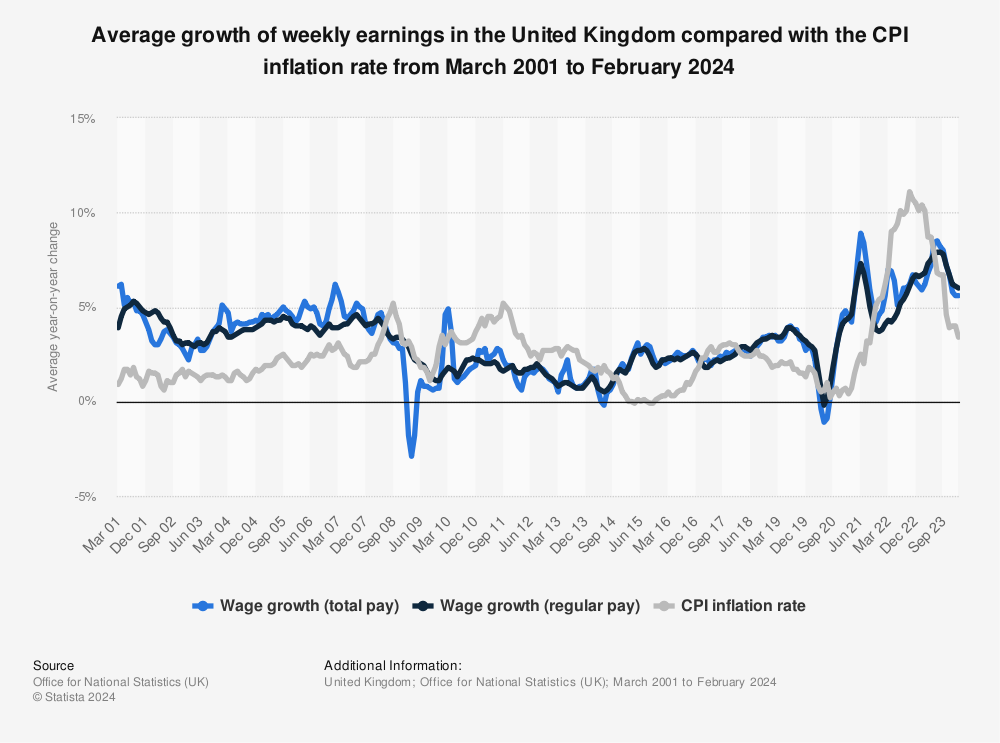
As you can see, wage growth, both total and regular, has fluctuated over the period, with peaks and troughs that correlate to economic cycles, policy changes, or significant economic events. What’s also clear is that inflation, as measured by the CPI, also shows variability, which is expected as it is influenced by factors such as energy prices, currency strength, economic demand, and supply chain dynamics.
Over the last two decades or so, it’s clear that there are periods where wage growth outpaces inflation, which suggests real income growth (where the purchasing power of individuals increases). Conversely, there are also times when inflation outstrips wage growth, indicating a decrease in real income (where the purchasing power of individuals decreases).
Some examples include:
Early 2000s to late 2000s: There was a long-term trend here where wage growth was higher than inflation, which may reflect the pre-financial crisis economic expansion.
Post-2008 to Mid-2010s: Following the 2008 downturn, there was a phase where inflation overtakes wage growth, which could relate to the age of austerity.
The late 2010s to Early 2020s: Wage growth was once again exceeding inflation. This era might reflect a period of relative economic stability and growth before the onset of the COVID-19 pandemic.
Post-2020: A particularly sharp increase in the CPI inflation rate surpasses wage growth in early 2022 and it has taken 18 months for wage growth to finally catch up.