
Should I sell my investments after a stock market crash?

Should I sell my investments after a stock market crash?
Introduction.
Investing in the stock market can be a rollercoaster ride, especially during periods of market volatility. It's often the case that just as you seem to be making up some ground, another news story hits, and the market takes a tumble. For many UK investors, the question of whether to sell investments after a market crash is emotionally charged – nobody likes losing money, particularly when large numbers are involved. However, history and financial principles strongly advocate for staying invested long-term, as it is generally more beneficial than trying to time the market.
The importance of time in the market.
There is an old saying that "time in the market is better than timing the market", which often holds true for several reasons. Historical data demonstrates that stock markets tend to recover over time. For instance, looking at the FTSE 100 over the past few decades, the overall trend has been upward despite numerous downturns. This resilience of the stock market should reassure you that even during a downturn, the market has the potential to bounce back. If you sell your investments during a downturn, you will lock in your losses, and in many cases, you will miss the following recovery.
Historical performance of the FTSE 100.
To illustrate this, consider the performance of the FTSE 100 from 1984 to 2024. Despite several significant drops, such as the 2008 financial crisis and the 2020 COVID-19 crash, the index has generally recovered and grown over the long term.
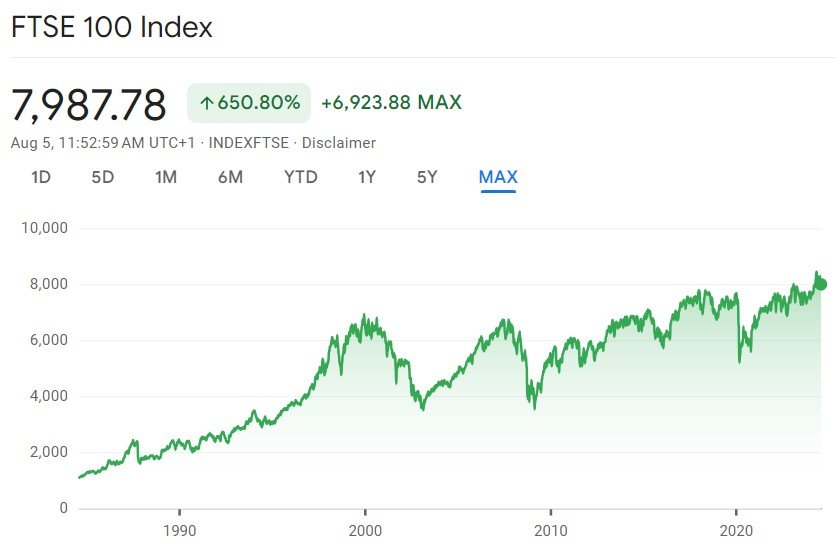
Graph showing FTSE 100 performance from 1984 to 2024. Source: Google.
Past performance is not a guide to the future.
Impact of overseas markets on UK investors.
It's important to note that one can't look at a single market in isolation, as globalisation means that UK markets are not insulated from overseas events. Economic turmoil in major markets like the US, Japan or the EU can impact the FTSE 100 and other UK investments. For instance, a downturn in the S&P 500 often leads to a drop in UK markets due to the interconnected nature of the global economy. However, this interconnectedness also means that the recovery of international markets can positively influence UK investments.
What do market dips mean for UK pension holders and stocks and shares ISAs?
For UK pension holders and those with other investments in ISAs or share accounts, the focus should always be on the long-term benefits of staying invested. Pensions and ISAs are typically designed for long-term growth, and frequent trading within these accounts can incur additional costs and tax implications, which erode returns.
The only time that a stock market crash should be of significant concern is when you are looking to sell down for major purchases or if you are looking to purchase an annuity. Otherwise, you need to hang on in there and try to think about something else.
A good way of thinking about it is to slow things down and compare the market pricing of other assets, such as your house. Most people don't continuously monitor the value of their home, and they don't have an estate agent coming through the door every day telling them they are up £10,000 today and down £15,000 the next—just because you can value your stock market investments at the click of a button doesn't mean you should!
Behavioural finance and emotional decision-making.
Behavioural finance highlights that emotional decision-making often leads to suboptimal investment outcomes. Fear and panic can drive investors to sell their assets during a market crash, crystallising losses. Instead, a disciplined approach that involves periodic reviews with a financial adviser can help ensure that investments are aligned with long-term goals without succumbing to short-term market movements.
Remember, it is well-documented that the fear of loss is psychologically more powerful than the pleasure of gains. This phenomenon, known as loss aversion, often leads investors to make irrational decisions during periods of market volatility, such as selling off assets prematurely to avoid potential losses. However, it's important to remember that market downturns also present opportunities for future gains, especially if you have a long-term investment strategy in place.
The importance of regular reviews with your financial adviser.
Rather than monitoring investments daily, UK investors should engage in periodic reviews with their financial advisers. This approach ensures that an investor's investment strategy remains aligned with their long-term objectives and risk tolerance, providing a steady hand in the face of short-term market volatility.
Zoom out.
The critical takeaway for UK investors worried about a stock market crash is to "zoom out" and view investments from a long-term perspective. Remember, the value of your investments is not just about today's market conditions, but about the potential for growth over the years. Historical data, the interconnected nature of global markets, and behavioural finance principles all support the strategy of staying invested through market downturns. Patience and a long-term view can be your best allies in navigating market volatility.
Investors can navigate market volatility and work towards achieving their financial objectives by focusing on long-term goals and regularly reviewing investment strategies with a financial adviser.
If you want to turn market dips into opportunities, build a war chest.
If, even after everything we've said so far, you still can't resist checking up on your investments and feel terrible when the market dips, one of the most effective strategies is building a war chest.
Your war chest is a reserve of cash funds specifically set aside to take advantage of market dips. This approach helps investors avoid panic selling and enables them to see downturns as opportunities to buy high-quality assets at discounted prices. By building a war chest, you're not just weathering the storm, you're actively preparing to make the most of market opportunities – what could be better than that?
Maintaining a war chest allows investors to capitalise on market downturns. High-quality investments can be purchased at a fraction of their intrinsic value when stock prices fall. This strategy can be particularly advantageous for UK investors with investments in ISAs and pensions, as they can increase their holdings in a tax-efficient way.
How to build a war chest:
Set aside a portion of your portfolio: Allocate a small percentage of your portfolio to cash or cash equivalents. This portion should be sufficient to make meaningful investments during market dips but not so large that it significantly detracts from your overall growth potential.
Automate your savings: Set up automated transfers from your income to regularly contribute to your war chest. This disciplined approach ensures that you consistently build your reserve without the need for active management.
Stay informed but not reactive: Keep an eye on market trends and economic indicators, but avoid making impulsive decisions based on short-term movements. Use your war chest strategically to buy assets that align with your long-term investment goals.
By shifting the focus from fear to opportunity, investors can reframe their emotional response to market volatility. Instead of worrying about losses, they can view downturns as chances to enhance their portfolios. This proactive approach mitigates the psychological impact of market crashes and positions investors to benefit from future recoveries.
Pound cost averaging: A disciplined approach to investing.
Pound cost averaging is another strategy that fits well with the long-term investment mindset and can help mitigate the emotional impact of market volatility. This approach involves regularly investing a fixed amount of money into the market, regardless of its current state.
By doing so, investors purchase more assets when prices are low and fewer when prices are high, which can lower the average cost per assets over time.
For UK investors, particularly those with ISAs or pensions, pound cost averaging provides a disciplined framework that reduces the pressure to time the market and helps manage the psychological effects of loss aversion.
This consistent investment strategy ensures that investors remain engaged with the market, steadily building their portfolios and capitalising on market fluctuations without the need for active trading decisions.
Case study: The COVID-19 market crash.
During the COVID-19 pandemic, global markets, including the FTSE 100, experienced significant declines. Investors with a war chest could purchase certain assets at significantly reduced prices. As the markets recovered, these investments yielded substantial returns, demonstrating the effectiveness of this strategy.

Graph showing the decline and subsequent recovery of the FTSE 100 during the COVID-19 pandemic. Source: Google.
Past performance is not a guide to the future.
Conclusion.
In conclusion, selling investments after a stock market crash is generally not advisable for long-term investors in the UK. By remaining invested, focusing on long-term goals, conducting periodic reviews with a financial adviser, and building a war chest for buying the dip, investors can better weather market downturns and benefit from eventual recoveries. The message is clear: time in the market beats timing the market.
What’s next?
If you need assistance with your personal finances, particularly in the context of investments, our advisers are here to help. You can get in touch with one of our advisors for independent financial advice and we offer a free initial consultation. Based in Royal Tunbridge Wells, we advise clients across the UK.
Don’t forget, this article offers general financial information and should not be taken as personal advice. Remember that investments and pensions can go up and down in value, so you could get back less than you put in. Tax rules can change and will depend on your individual circumstances.