
Can you invest responsibly without giving up on returns?

Can you invest responsibly without giving up on returns?
The assumption that responsible investing requires a financial trade-off has persisted for years, and for a long time it was not an unreasonable one. The practical evidence of performance was limited, and some of the early concerns were well-founded. In recent years that picture has changed considerably, and the relationship between values-based investing and financial returns is now better understood; though it remains more nuanced than either its advocates or its critics have sometimes suggested.
Growing numbers of UK investors want to know whether they can align their portfolio with their values without compromising the long-term performance they need. The short answer is yes, but it requires clarity about what responsible investing actually means, which approaches suit your circumstances, and how to assess whether a fund is genuinely doing what it claims.
This article sets out the main approaches to responsible investing, what the evidence suggests about performance, and the practical questions worth considering before making any changes to your portfolio.
What Does Responsible Investing Actually Mean?
Responsible investing is an umbrella term for a range of approaches that allow investors to take environmental, social, or governance factors into account alongside financial returns. The most widely used framework is ESG (Environmental, Social and Governance), which evaluates companies across three broad dimensions: how they manage environmental risks such as carbon emissions and resource use; how they approach social responsibilities including labour practices and supply chain standards; and how well they are governed in terms of board structure, executive accountability and shareholder rights.
ESG investing does not mean the same thing across all funds. Some use negative screening, simply excluding certain industries or companies from the portfolio (tobacco, weapons, fossil fuels and gambling are the most common examples). Others take a positive screening approach, selecting companies that score well on ESG metrics regardless of sector. A third approach involves engagement: remaining invested in companies and using shareholder influence to encourage better practices over time, rather than avoiding them altogether.
Beyond ESG, there is also impact investing, a more targeted approach in which capital is directed towards specific social or environmental outcomes such as renewable energy infrastructure, affordable housing or healthcare access. Impact investing tends to be more specialist in nature and is typically accessed through dedicated funds rather than mainstream portfolios.
Finding this useful?
Once a month, we send our latest articles on pensions, investments, mortgages, protection, estate planning and more - along with a couple you might have missed. Practical reading for anyone taking their finances seriously.
Join our readers →Does Responsible Investing Mean Lower Returns?
Not necessarily, though the honest answer is more nuanced than either its advocates or its critics have tended to suggest. In the earlier years of ethical investing, funds often operated with narrower investment universes, which limited diversification and affected performance in certain market conditions. That was a legitimate concern at the time, and one worth acknowledging.
Past performance isn’t a guide to future returns.
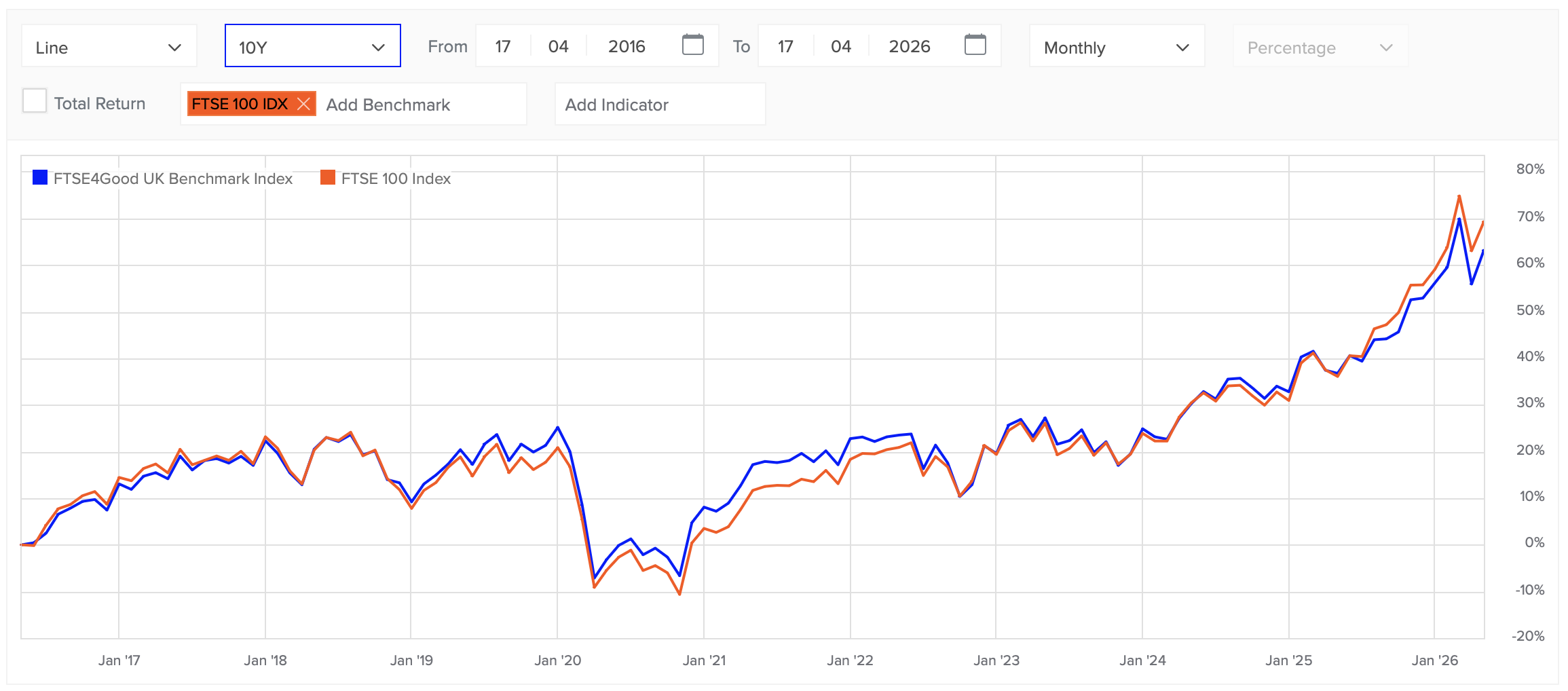
FTSE 4GOOD UK IDX vs FTSE100 IDX 2016-2026. Credit: londonstockexchange.com
The long-term evidence is instructive, and the FTSE4Good UK Benchmark Index provides a useful illustration. Compared against the FTSE 100 over the past decade (2016-2026), the two indices tracked each other closely for the majority of that period, moving through the Covid crash of 2020 and the subsequent recovery in near-lockstep. A meaningful gap has emerged more recently, as energy and defence stocks (sectors excluded from most ESG portfolios) have performed strongly in response to geopolitical and commodity market conditions. That divergence is real and worth understanding, but it reflects a specific set of circumstances rather than a structural penalty for investing responsibly.

Past performance isn’t a guide to future returns.
Xtrackers MSCI World ESG UCITS ETF vs iShares Core MSCI World UCITS ETF USD (Acc). Credit: JustETF.com
The global picture is just as instructive. A comparison of the Xtrackers MSCI World ESG ETF against the iShares Core MSCI World ETF (both widely held, publicly listed funds tracking their respective indices) shows cumulative returns of +160.89% and +160.17% respectively over the eight years to April 2026. The difference amounts to less than one percentage point across eight years of investing. The chart, available on justETF.com, shows two lines that are for the most part indistinguishable; moving through the Covid crash of 2020 and the recovery that followed in near-lockstep, with no sustained divergence visible in either direction over the full period.
There is also a governance argument that supports the long-term investment case. Companies that manage environmental risks carefully, treat employees and suppliers fairly, and operate with strong governance structures tend to be better-run businesses. Those characteristics are associated with resilience over time and do not guarantee outperformance, but they are qualities that many investors would regard as indicators of long-term business quality regardless of any broader ethical motivation.
The caveats matter, however. Responsible investing does not remove investment risk, and ESG funds are not inherently lower risk simply because they exclude certain sectors. The performance gap relative to broader indices can run in either direction, depending on market conditions and which parts of the market happen to be in favour at any given time.
Thinking about responsible investing?
We work with clients across the UK who want to build a portfolio that reflects their values without losing sight of their financial objectives. Find out how we approach responsible investing and what that means in practice.
Responsible investing →Can You Trust an ESG Fund's Label?
Not always, and that is one of the genuine challenges in this area. The term greenwashing refers to the practice of presenting an investment product as more sustainable or ethical than it actually is. Regulatory bodies including the FCA have increased their scrutiny of ESG fund labelling and disclosure requirements in response to growing evidence of inconsistency between how products are described and what they actually hold.
Different ESG rating agencies use different methodologies, and the same company can receive materially different scores depending on which agency is consulted. A fund described as sustainable by one provider may not meet the criteria used by another. This does not mean responsible investing is unreliable; it means that a label alone is not enough, and the substance behind it matters.
Understanding what a fund actually holds, how it screens or selects companies, and what its approach to shareholder engagement looks like are all questions worth asking. A financial adviser with experience in responsible investing can help you assess whether the options available are genuinely aligned with your values and your financial objectives, rather than simply marketed in that direction.
What Should You Consider Before Investing Responsibly?
The most useful starting point is clarity about what matters most to you. Some investors have specific exclusions in mind: they do not want exposure to tobacco, weapons or fossil fuel producers. Others are motivated by a broader commitment to environmental sustainability. Others still are primarily focused on governance quality as a proxy for long-term business resilience, regardless of any wider ethical motivation.
These different starting points lead to different approaches, and they do not all produce the same portfolio. A clearly articulated set of priorities makes it considerably easier to identify funds and strategies that genuinely reflect your intentions, rather than simply reacting to fund names or marketing descriptions.
It is also worth considering responsible investing in the context of your wider financial plan. How assets are held, whether through an ISA, a pension, or other structures, affects how your portfolio functions and what returns you actually receive after tax. Integrating responsible investment choices into an appropriate, tax-efficient structure is part of building a portfolio that works as a whole, rather than making isolated changes that may not sit well together.
Responsible investing has matured considerably as a discipline, and the range of credible options available to UK investors has expanded. The question is no longer simply whether it is possible to invest responsibly without giving up on returns; the more useful question is how to do it well, with a clear sense of what you are trying to achieve and why.
What's Next?
If you want to explore whether responsible investing is right for you, and how it might fit within your broader financial plan, speaking with a Chartered Financial Adviser is a sensible place to start.
Our Chartered Financial Advisers offer a free initial consultation to anyone who wants to discuss responsible investing options. It is a focused conversation, not a sales call.
We work with clients across the UK. Locally, we advise clients throughout Kent and East Sussex, including Tunbridge Wells, Sevenoaks, Maidstone, Tonbridge, Crowborough and Eastbourne.
This article is for general information only and does not constitute personal financial advice or a recommendation. The suitability of any investment approach depends on individual circumstances, objectives and the current regulatory environment. Tax treatment and investment rules can change over time, and their effect will depend on personal circumstances. Investments can go down as well as up, and you may get back less than you invest.