
What is a power of attorney (LPA) and why do you need one?

What is a power of attorney (LPA) and why do you need one?
We believe a Power of Attorney is something everyone should have, regardless of age, marital status or wealth. In this article we explain what a Power of Attorney is, why you need one, how it can be used, and what to do if you suspect an Attorney of wrong-doing.
What is a Power of Attorney?
A Power of Attorney (POA) is the term for a legal document that lets you appoint one or more people to help you make decisions or to make decisions on your behalf. There are three types of POA (which we outline below) and which one you set up will determine whether you give those people authority to make decisions over your financial affairs, your personal affairs (like your health), or both.
The person who sets up the POA is known as the donor.
The people who are appointed to make the decision are known as the attorneys.
What is the purpose of a Power of Attorney?
A Power of Attorney gives you more control over what happens to you if you have an accident or an illness and you cannot make your own decisions. Not being able to make your own decisions or judgments is known as lacking mental capacity. Although not all POAs require you to have lost mental capacity for them to be used.
By setting up a POA, you can give somebody legal authority to act on your behalf to deal with your financial or personal affairs.
Types of powers of attorney.
There are three types of POA:
Ordinary power of attorney (OPA) gives an attorney the authority to make decisions (as specified by the donor) while the donor still has mental capacity but needs some temporary help to manage their affairs, for example because of illness.
It does not need to be registered with the Office of the Public Guardian (OPG). Therefore, it will be effective immediately or from the date specified by the donor.
It will last until the expiry date, or until the donor loses mental capacity or revokes authority.
Enduring power of attorney (EPA) gives an attorney the authority to make decisions about the donor’s finances and property. EPAs are no longer available but are valid if correctly made and signed before 1 October 2007.
If the donor still has mental capacity, an existing EPA can be used without being registered with the Office of the Public Guardian (OPG).
If the donor lacks capacity the EPA must be registered to be used (even if it was already in use while the donor had mental capacity).
It will last until the donor dies or revokes authority.
Lasting power of attorney (LPA) gives an attorney the authority to make decisions about finances and property with the donor’s permission and health and welfare (if chosen) when they lose capacity.
It must be registered with the Office of the Public Guardian (OPG), at which point it becomes effective - if the donor still has mental capacity only decisions on finance and property can be made by the attorney(s) at this stage.
The decisions over health and welfare can only be made by the attorney(s) once mental capacity has been lost.
It will last until the donor dies or revokes authority.
Here is a summary of the pros and cons of each type of POA:
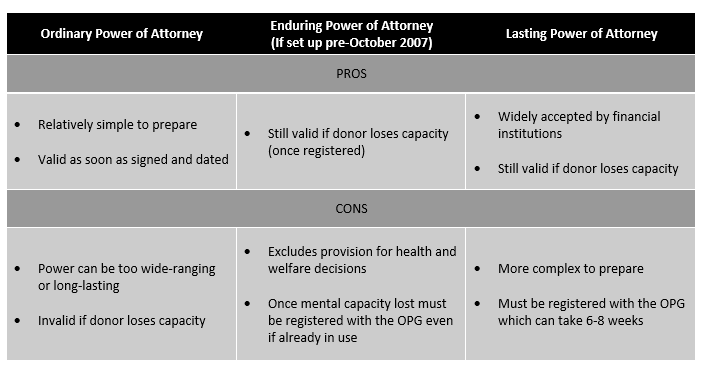
Pros and cons of each type of POA.
Why is a Power of Attorney important?
Mental capacity can decline as a result of injury, illness, learning difficulties, mental health problems or substance misuse. It can be permanent, temporary or even sometimes fluctuating depending on the individual circumstances.
The number of people suffering from dementia and related conditions is increasing. According to the Alzheimer's Society, it is now estimated that one person develops dementia every three minutes in the UK.
Someone may want to make a POA:
Temporarily, for example because they’re in hospital or abroad for a long time; or
For the long term, if they lose mental capacity to make decisions for themselves in the future.
How does a Power of Attorney work?
There are strict rules for how Power of Attorneys operate which are laid out in the Mental Capacity Act (MCA) 2005. The Mental Capacity Act 2005 is a law that protects vulnerable people over the age of 16 around decision-making.
The MCA 2005 sets out 5 key principles for attorneys to follow:
A person must be assumed to have capacity unless it is established that he lacks capacity.
A person is not to be treated as unable to make a decision unless all practicable steps to help him to do so have been taken without success.
A person is not to be treated as unable to make a decision merely because he makes an unwise decision.
An act done, or decision made, under this Act for or on behalf of a person who lacks capacity must be done, or made, in his best interests.
Before the act is done, or the decision is made, regard must be had to whether the purpose for which it is needed can be as effectively achieved in a way that is less restrictive of the person's rights and freedom of action.
The MCA 2005 explains that a person is deemed to be unable to make their own decisions if they cannot do one or more of the following things:
Understand information relevant to the decision;
Retain that information;
Use or weigh that information as part of the decision-making process; or
Communicate their decision (by any means).
Can you lose your money through a Power of Attorney?
Attorneys have a legal duty to act in the best interests of the donor. Sadly this does not prevent attorneys abusing their power, but if this is abuse is discovered there will be legal repercussions on the attorneys. This is why it’s so important that:
a) the donor only appoints a person or people they trust to act on their behalf; and
b) the attorney(s) understand their responsibilities and legal duties when agreeing to the role.
An attorney MUST:
Follow any instructions the donor included in the LPA
Consider any preferences the donor included in the LPA
Help the donor make their own decisions as much as they can
Make any decisions in the donor’s best interests
Respect their human and civil rights
Make the decisions themselves - they can’t ask someone to make them in their place
When there is more than one attorney, the legal document can be drawn up in two different ways:
‘Jointly’ - this means all the attorneys must agree to decisions being made
‘Jointly and severally’ - this means the attorneys can make decisions together or on their own
The OPA/EPA/LPA may specify that some decisions can be made jointly and others jointly and severally.
What to do if you suspect an Attorney is abusing their power.
An attorney may be abusing their position if they:
Stop relatives or friends contacting the donor
Refuse to let healthcare or social care workers see the donor
Apply for a loan or credit card in the donor’s name
Spend the donor’s money unusually or extravagantly
Take the donor out of hospital against medical advice
Make large gifts to themselves
If you suspect that an attorney may be misusing a POA or acting dishonestly, you must contact the Office of the Public Guardian (OPG) Safeguarding Unit immediately.
The OPG will then check if it has the legal authority to investigate.
Office of the Public Guardian: opg.safeguardingunit@publicguardian.gov.uk / Telephone: 0115 934 2777
You can also contact:
Jobcentre Plus for concerns about benefits.
Your local adult social services for concerns about care or safeguarding.
The Care Quality Commission or the Care Inspectorate Wales if you’re concerned about someone who’s living in a care home.
You should also contact the police if you suspect psychological, physical or sexual abuse, theft or fraud.
How do you set up a Power of Attorney?
A solicitor will be able to:
Help set up a POA.
Check the donor has mental capacity to make a POA.
Advise the donor on their choice of attorney.
Act in a professional capacity as the donor’s attorney.
The donor must have mental capacity when they make a POA.
How we can help
At AV Trinity we will discuss the importance of POAs with our clients where one is not in place and encourage one to be set up regardless of your age. We work closely with local solicitors who can do this and we take no payment whatsoever for referring you to them.
Where our clients have a POA in place, we will ensure that where it is enacted/registered, any instructions we receive are in line with the specific requirements as detailed within the POA itself and in line with the guidance laid out in the Mental Capacity Act Code of Practice, as far as we are able to. If we are in any doubt we will engage with the donor (if possible), the attorneys and any other relevant parties to resolve any potential issues or concerns.
We take the welfare of our clients extremely seriously and if we believe there is any wrongdoing we will raise this with the relevant authorities where concerns cannot be resolved.
Where you can find out more about POAs:
Mencap is a charity based in the United Kingdom that works with people with learning disabilities. They offer useful support and guidance in respect of the Mental Capacity Act.
The government website provides practical information on making, registering and ending a Lasting Power of Attorney.
The Law Society (the independent professional body for solicitors in England and Wales) offers detailed information on POAs, including preparing a power of attorney, choosing an attorney and acting as an attorney.
The Mental Capacity Act Code of Practice giving guidance for decisions made under the Mental Capacity Act 2005.
All information is correct at the time of publication. This article offers information about financial planning and should not be taken as personal advice.